Introduction
Hoxhunt threat analysts observed a nearly 500% increase in FIFA World Cup 2026-themed phishing attacks on employees from April to June 2026, with the sharpest spike aligning with the tournament kick-off period. Threat analysts observed exponentially more World Cup 2026-themed attacks than Paris 2024 Olympics attacks. Low but consistent attack activity appeared as early as February before campaign volume accelerated sharply from May onward. The findings suggest that attackers are increasingly exploiting major global events as temporal phishing lures, blending malicious messages into the rising volume of legitimate marketing, recruitment, sponsorship, and promotional communications surrounding the World Cup.
This follows a similar pattern Hoxhunt observed in spring 2026, when U.S. tax authority impersonation campaigns increased by over 400% and overall U.S. phishing volume rose 147.3%. In that report, Hoxhunt identified tax phishing as a workplace-relevant seasonal threat because tax deadlines intersect with real corporate workflows such as payroll, finance, HR documentation, and regulatory reporting. The FIFA World Cup findings point to a broader trend: attackers are getting better at turning real-world moments into credible workplace phishing campaigns.
Key findings
- Nearly 500% increase in FIFA World Cup 2026-themed phishing attacks from April to June 2026.
- Sharpest increase in activity coincided with kickoff.
- Low but consistent campaign activity was observed as early as February, with volume accelerating sharply from May onward.
- Two dominant campaign types:
- 1) fake marketing recruitment lures targeting marketing professionals
- 2) prize/bundle scams impersonating Coca-Cola’s World Cup promotions.
- Temporal phishing simulations, like this World Cup campaign, are 42% more likely to draw clicks than non-temporal simulations, according to Hoxhunt data.
- Reported FIFA-themed threats were distributed evenly across regions at a global level.
- Paris 2024 Olympics and Eurovision 2026 campaign volumes were significantly lower; World Cup has been an exceptionally popular entertainment event for cyber-criminal purposes.
Methodology
Hoxhunt analyzed tens of millions of real threat reports submitted by 4M+ Hoxhunt users. Every Hoxhunt user’s threat report is automatically analyzed by our native-AI platform and then categorized as: safe (legitimate communications or harmless spam); possibly malicious; likely malicious; or malicious. Malicious attacks are grouped, categorized, prioritized for SOC response and, if desired, auto-removed by the Hoxhunt incident response system. Moreover, attacks are categorized into a purpose-built phishing framework covering the various themes and techniques observed in the threat landscape, offering the end-user and security team granular visibility into what types of attacks are landing in inboxes.
For this research, threat data was queried and filtered for FIFA World Cup 2026-themed phishing attacks reported up through June 2026. Results were reviewed by a team of threat analysts to confirm relevance.
The findings are based on threats that reached employee inboxes and were reported by users, rather than generic filter-level telemetry. This distinction matters because employee-reported threats provide a clearer view into the attacks people are actually seeing at work.
The model is built to recognize and categorize even new, zero-day phishing attacks, which can be reported by a Hoxhunt user on one side of the globe, and then the AI is trained to recognize and respond to similar campaigns everywhere.
Campaign characteristics
1. Fake FIFA recruitment lures targeting marketing professionals
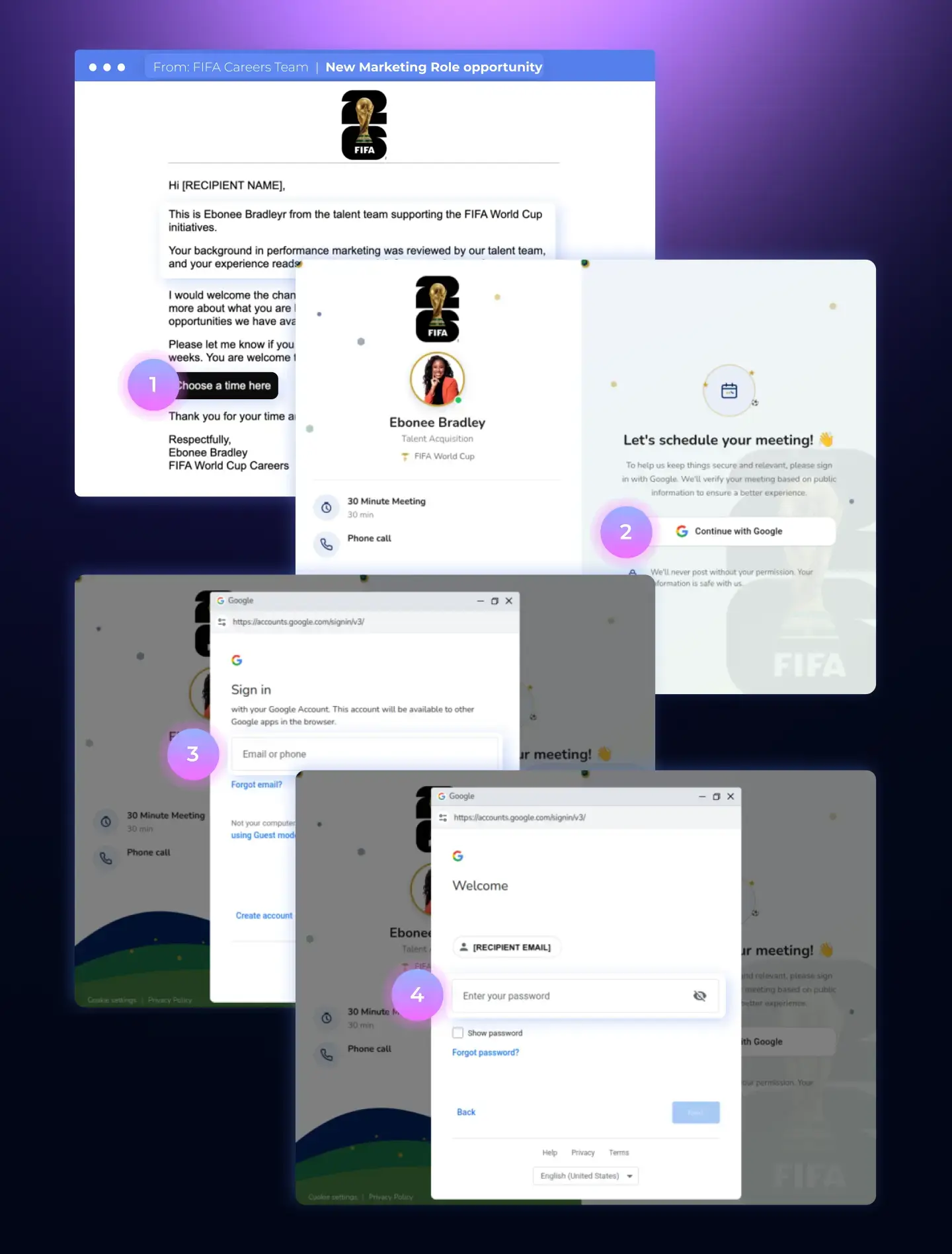
One dominant campaign type impersonated FIFA World Cup-related recruitment outreach. These messages posed as marketing or event-related job opportunities and were targeted more heavily toward marketing professionals.
The attack chain led recipients to click a malicious link that opened a Browser-in-the-Browser credential harvesting page, designed to mimic a Google sign-in prompt. This technique makes the credential request appear familiar and legitimate, especially when paired with a plausible recruitment pretext.
This campaign type is effective because it feels aspirational, timely, and professionally relevant without needing to be expected. A message from an impressive global brand connected to the FIFA World Cup can trigger curiosity fast: Is this real? Why me? Could this be a dream opportunity? That emotional pull is stronger during a major event, when public attention and excitement around the World Cup are already high.
Its credibility comes from the quality of the full attack chain. The initial recruitment email is polished and role-specific. The scheduler page looks legitimate. The fake Google sign-in flow closely mimics a familiar authentication experience. Together, those elements reduce friction and make each next click feel natural. The temporal hook makes the lure more compelling; the professional branding and convincing pages make it harder to dismiss.
2. Coca-Cola World Cup prize and bundle scams
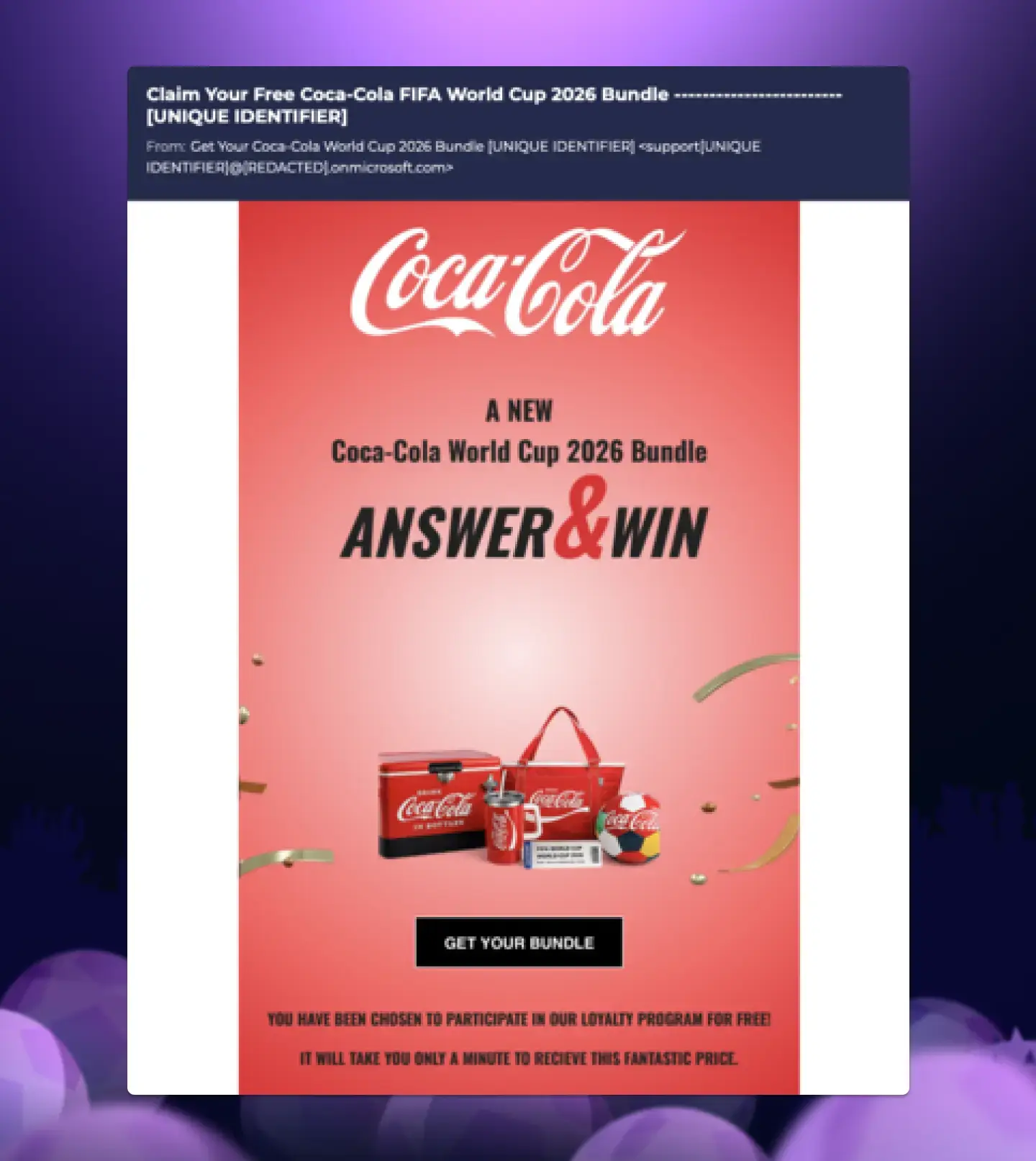
The second dominant campaign type impersonated Coca-Cola’s World Cup promotion activity. These messages used World Cup excitement and a fake loyalty or prize-bundle offer to lure recipients into clicking a malicious link.
Brand impersonation works especially well around major events because people expect to see promotional campaigns from major sponsors. Coca-Cola is strongly associated with global sporting events, making the lure feel culturally familiar and commercially plausible.
In this case, the danger is not only the brand impersonation. It is the timing. As legitimate World Cup communications increase, malicious messages can hide among real campaigns, offers, internal chatter, customer promotions, and social content.
A broader trend: attackers are productizing the calendar
The FIFA World Cup findings suggest that major events, from tax filing season to sports, are increasingly being exploited as phishing infrastructure. Targeting and personalization is easier for criminals to accomplish with AI, and in 2026 AI is powering most phishing attacks today: a 14X jump in AI-generated attacks was observed by Hoxhunt at the turn of 2025 to 2026.
The volume increase was sharper than comparable event-themed campaigns around the Paris 2024 Olympics and Eurovision 2026, but those events followed a similar pattern: low early activity, followed by acceleration as the event became more relevant.
This may reflect a broader shift in the cybercrime-as-a-service market. Phishing kits are becoming easier to create, localize, modify, and deploy. Generative AI can help attackers produce more polished messages, tailor them to specific regions or roles, and rapidly iterate campaign variants. Hoxhunt’s Phishing Trends Report noted that AI-generated phishing campaigns surged by over 14X after previously hovering under 5% of observed attacks, stabilizing at roughly 50% of all observed attacks.
That does not prove the FIFA campaigns were AI-generated. But the pattern is consistent with an environment where attackers can more easily build credible event-themed campaigns at scale. The barrier to launching polished temporal phishing is falling.
Implications for security teams
World Cup-themed phishing should not be treated as a novelty campaign. It is a signal that attackers are aligning lures with global attention cycles and workplace relevance.
Security teams should consider:
- Running event-themed simulations before and during major global events.
- Tailoring simulations by role, especially for marketing, communications, sales, HR, travel, and executive assistants.
- Training employees to scrutinize recruitment messages, sponsor promotions, prize bundles, and brand impersonation lures.
- Warning employees about Browser-in-the-Browser credential prompts and fake Google sign-in pages.
- Using real threat reports to update awareness content quickly, rather than relying only on static annual training calendars.
- Tracking whether event-themed attacks spike again around major World Cup milestones, finals, ticketing moments, and sponsor campaigns.
Conclusion: targeted moments demand targeted training
The nearly 500% increase in FIFA World Cup-themed phishing attacks from April to June 2026 suggests that attackers are using global sporting events as high-credibility social engineering moments. The simulation data reinforces the risk: temporal lures compared with similar contexts in simulations are 42% more likely to succeed.
Temporal phishing attacks exploit moments when people expect unusual communication and thus lower their defenses against emotionally charged pre-texts. During tax season, employees may expect messages about documents, filings, refunds, payroll, or compliance. During the World Cup, employees may expect messages about promotions, events, travel, tickets, sponsorships, recruiting, campaigns, media, or giveaways.
Hoxhunt’s earlier tax phishing research showed how attackers use seasonal context to make malicious messages feel normal. That campaign involved over 400% growth in U.S. tax authority impersonation campaigns, a 147.3% increase in malicious phishing emails reported by U.S. users overall, and a 16% failure rate for personalized, tax-themed simulations compared to a 4–6% global average failure rate.
The World Cup data shows a similar behavioral pattern. Temporal simulations were 42% more likely to trick users into clicking than non-temporal simulations, even though simulated phishing report rates were not significantly different. That suggests employees are more likely to fall for a scam when its relevant to the time surrounding a well-known event.
The bigger story is the rise of well-executed temporal phishing. Tax season, sporting events, major cultural moments, business cycles, and internal workflows all create windows where employees expect more communication, more urgency, and more unusual requests. Attackers are learning to exploit those windows.
The defensive answer is to close the loop between threat intelligence and training. When the threat feed shows attackers hijacking the calendar, awareness programs should move with it.