HRM vs training-led security
Traditional security awareness programs assume that if users know better, they’ll act better.
HRM challenges that assumption. From what we see in security teams:
- Training completion ≠ secure behavior
- Phishing simulation results plateau after 6-12 months
- Users often don’t know where or how to report real threats
HRM software closes this gap by focusing on observable behavior, not theoretical knowledge.
What HRM software actually does
A modern HRM platform typically operates across three layers:
The measurement gap is concrete. A completion-based program might produce roughly 4,000 behavioral data points a year, while a continuous behavior-change program generates around 180,000 for the same workforce (Hoxhunt Phishing Trends Report 2026). That volume of signal is what lets HRM score risk at the individual level instead of reporting averages.
Key capabilities that define human risk management
Not all vendors labeled “HRM” actually meet this bar. At minimum, true HRM platforms include:
- Individual-level risk scoring (not just aggregate reporting)
- Adaptive phishing simulations (difficulty adjusts to user skill)
- Real threat reporting workflows (not just simulations)
- Behavior-triggered micro-training (just-in-time, not scheduled)
- Integration with email, identity, and SOC tools
This is where the category starts to separate and where many training platforms fall short.
How is human risk management different from security awareness training?
Security awareness training (SAT) is usually designed to educate. Human risk management is designed to reduce measurable risk.
Security teams are no longer just asking if employees completed, they’re asking tougher questions:
- Are users getting better at spotting real threats?
- Can we identify which people or teams create the most risk?
- Does the platform adapt based on behavior?
- Can we prove that human-layer risk is declining?
SAT focuses on knowledge and awareness, while HRM adds behavioral analytics, targeted interventions, and continuous monitoring to drive real behavior change.
The simplest difference: knowledge vs behavior
SAT assumes that once people know the rules, they will follow them.
HRM starts from a more realistic premise: people do not always act on what they know. They forget, rush, guess, click, misreport, and work around friction. So the job is not just to educate them once, it’s to measure behavior continuously and improve it over time.
That is why HRM platforms tend to include:
- User-level behavioral signals
- Risk scoring
- Adaptive phishing or intervention logic
- Micro-training triggered by actions
- Threat reporting workflows
- Dashboards that show movement in risk, not just completion rates
The KPI problem: completion is easy, proof is hard
One reason this category is evolving so quickly is that old SAT metrics are increasingly weak buying signals. The problem is that SAT alone often cannot tell a credible risk-reduction story.
The proof shows up when a program measures behavior, not completion. Where completion-based training plateaus, behavior-change programs keep moving the needle: real-threat detection climbed from 13% to 71% as employees progressed through the program, and reporting of suspicious messages improved roughly 6× within six months (Hoxhunt Phishing Trends Report 2026, pp. 6, 37–39). Those are behavioral outcomes a completion rate can’t show.
Completion rate is easy to report upward. It is much harder to prove that completion changed anything meaningful.
That is why HRM is gaining traction with security leaders who want stronger evidence:
- Did reporting rates improve?
- Did repeat-risk users improve faster with adaptive interventions?
- Did high-risk groups become easier to identify and coach?
- Did the SOC get more useful human-generated signals?
Which vendors are positioned as human risk management platforms?
The human risk management category is still evolving, which means vendor positioning is often ahead of actual capability.
Many platforms now use HRM language, but they fall across a spectrum:
- True HRM platforms (behavior + risk + intervention)
- Awareness-first platforms (training + phishing)
- Security platforms with HRM features layered in
Core vendors in the human risk management landscape
These vendors are frequently evaluated under the human risk category:
- Hoxhunt: Behavior-first HRM platform focused on adaptive training, real threat reporting, and measurable risk reduction
- CybSafe: Strong emphasis on behavioral science, analytics, and human risk scoring
- Mimecast Engage Awareness Training: Combines awareness training with behavioral signals and targeted interventions
- NINJIO: Focuses on engaging, story-driven training with personalization elements
Awareness-led platforms expanding into HRM
These vendors are not traditionally HRM but are increasingly adopting HRM positioning:
- KnowBe4: Market leader in security awareness training, now layering in risk scoring and adaptive elements
- Proofpoint Security Awareness: Combines phishing simulation and training with threat intelligence-driven personalization
- Guardey: Gamified awareness platform with lightweight behavioral features
Adjacent or emerging players
Some vendors are occasionally included in HRM conversations due to overlapping capabilities:
- Phished: Focused on phishing simulations and awareness
- Arctic Wolf: Integrates awareness into a broader managed security platform
- Huntress: Combines human coaching with managed detection and response
The key distinction buyers should use
Instead of relying on category labels, use this test:
Does the platform continuously measure behavior, assign risk, and adapt interventions at the individual level?
If yes → it’s likely true HRM
If no → it’s likely awareness-led or adjacent
Which platforms focus on phishing, identity, or broader human behavior?
Not all human risk management platforms are trying to solve the same problem.
Some are optimized for phishing defense, others for identity-related risk, and a smaller group focuses on holistic human behavior across multiple attack vectors.
Understanding this split helps you avoid a common mistake – buying a phishing platform when you actually need behavior change across the organization.
Phishing-focused platforms
These platforms are primarily designed to:
- Simulate phishing attacks
- Train users to detect suspicious emails
- Improve reporting rates
They are often:
- Highly effective at improving phishing resilience
- Easier to deploy quickly
- Familiar to most security teams
Best for:
- Organizations early in maturity
- Teams prioritizing phishing as the primary threat vector
Identity & behavior-signal-oriented platforms
These platforms move closer to HRM by:
- Incorporating user context
- Leveraging risk signals
- Adapting interventions based on behavior
Best for:
- Teams that want risk visibility + analytics
- Organizations moving beyond basic awareness
Broad human behavior platforms (full HRM scope)
These platforms treat human risk as a continuous, measurable system, not a set of campaigns.
They typically:
- Go beyond phishing into decision-making behavior
- Integrate with real threat reporting workflows
- Deliver adaptive, personalized interventions at scale
Best for:
- Enterprises prioritizing measurable human risk reduction
- Security teams integrating human signals into SOC workflows
The strategic trade-off
Each category reflects a different philosophy:
- Phishing-first platforms → optimize for detection of one attack vector
- Signal-driven platforms → optimize for visibility into human risk
- Full HRM platforms → optimize for continuous behavior change
The key is alignment. If your goal is to reduce phishing clicks, a simulation-heavy platform may be enough. If your goal is to reduce human-driven risk across the business, you need broader HRM capabilities.
How to choose the right focus
Choose phishing-focused if:
- Phishing is your dominant threat
- You need quick wins
Choose behavior-signal platforms if:
- You need visibility into risk
- You want to segment users and prioritize interventions
Choose full HRM platforms if:
- You need measurable risk reduction
- You want to operationalize human behavior as part of your security stack
Best human risk management software: vendor shortlist (2026)
Hoxhunt
Hoxhunt is built around a behavior-first model where employees become active threat detectors, not just trained users. The platform focuses on continuous behavior change and real-world signal generation.

Best for: Organizations prioritizing measurable human risk reduction and real threat reporting
Where it stands out:
- Real threat reporting as a core capability, not just simulations
- Adaptive phishing that evolves based on user skill and behavior
- High engagement via gamification and positive reinforcement
- Continuous learning model instead of scheduled campaigns
Where to pressure-test:
- Requires alignment with SOC workflows to fully unlock value
- Reporting and response processes need to be clearly defined internally
- Best results come when integrated into broader security operations
When this is the wrong choice:
- If your goal is purely compliance-driven awareness training
- If you’re not ready to operationalize human risk as part of detection
CybSafe
CybSafe approaches HRM from a behavioral science and analytics-first perspective, focusing on measuring and modeling human risk rather than primarily delivering training.

Best for: Security teams that want deep visibility into human risk and behavior patterns
Where it stands out:
- Strong human risk scoring and behavioral analytics
- Clear identification of high-risk users and groups
- Data-driven approach aligned with security metrics and reporting
Where to pressure-test:
- Less emphasis on phishing simulation depth compared to other platforms
- Intervention mechanisms may require pairing with training workflows
- Requires maturity to act on insights, not just observe them
When this is the wrong choice:
- If you want an out-of-the-box training-heavy solution
- If your team is not set up to act on behavioral insights
Mimecast Engage Awareness Training
Mimecast Engage extends a traditional awareness model with risk-based targeting and behavioral signals, especially within email-centric environments.
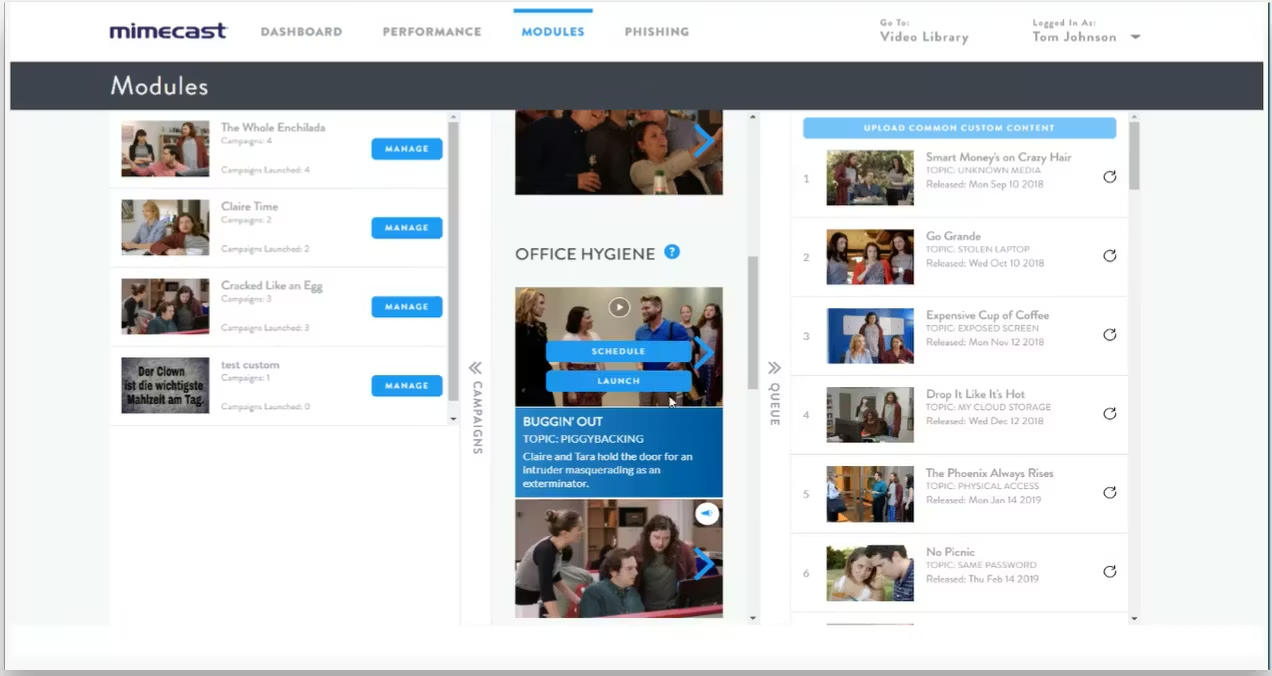
Best for: Organizations already invested in Mimecast looking to expand into HRM capabilities
Where it stands out:
- Tight integration with email security ecosystem
- Risk signals used to trigger targeted interventions
- Familiar model for teams transitioning from awareness platforms
Where to pressure-test:
- Still partially anchored in awareness-first architecture
- Behavioral modeling depth is more limited than dedicated HRM platforms
- Effectiveness depends on broader Mimecast ecosystem usage
When this is the wrong choice:
- If you want a standalone, behavior-first HRM platform
- If your security stack is not centered around Mimecast
NINJIO
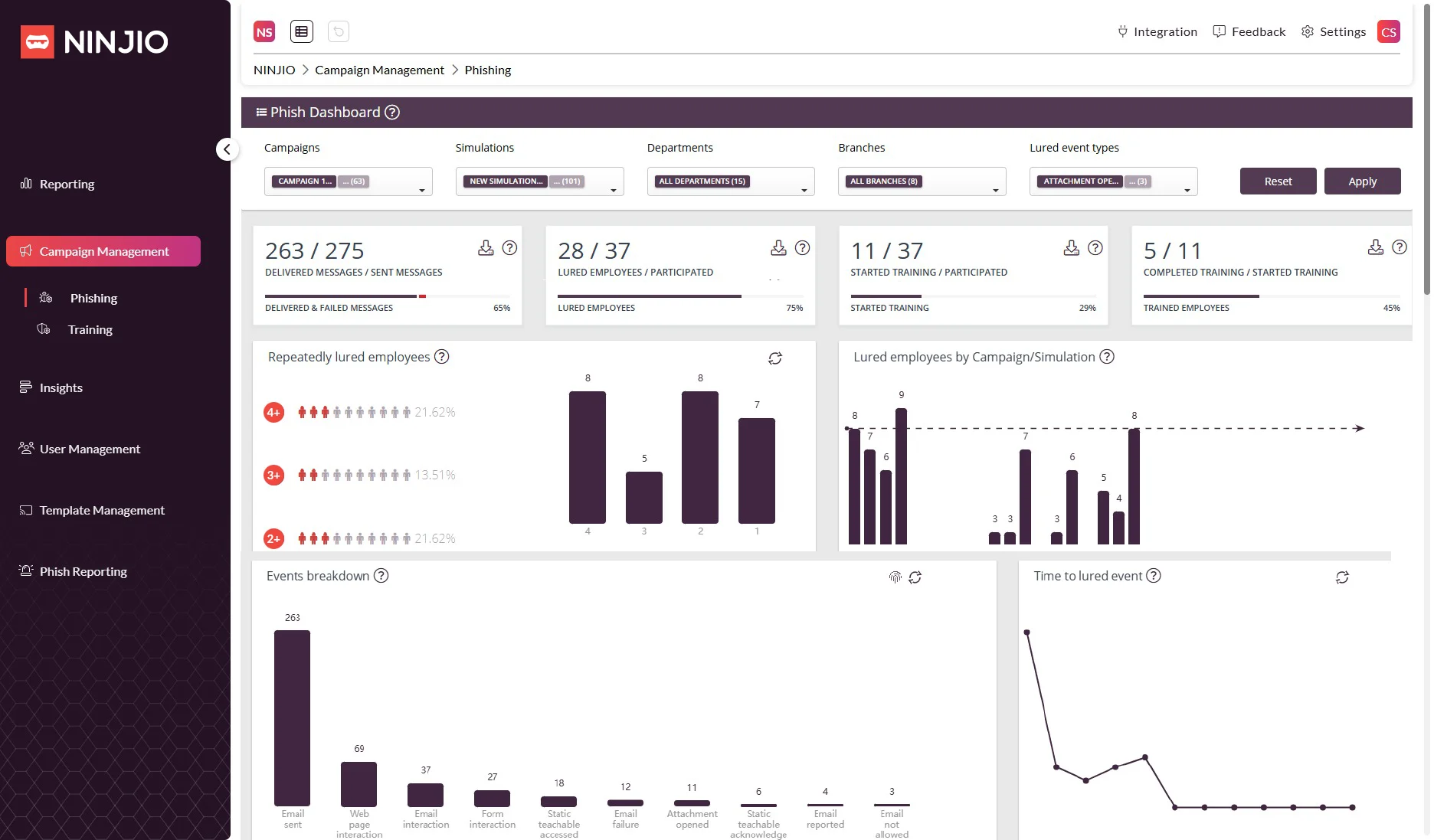
NINJIO focuses on engagement-led behavior change, using storytelling and media-driven training to drive awareness and retention.
Best for: Organizations prioritizing user engagement and security culture improvement
Where it stands out:
- Highly engaging, story-driven training format
- Strong adoption and completion rates across users
- Effective at improving baseline awareness and participation
Where to pressure-test:
- More training-centric than behavior-centric
- Limited depth in continuous risk scoring and adaptive interventions
- Less focus on real-time or behavior-triggered responses
When this is the wrong choice:
- If you need measurable, data-driven risk reduction
- If your priority is behavioral analytics and user-level risk scoring
KnowBe4
KnowBe4 is one of the most widely adopted platforms, built around scalable awareness training and phishing simulation at enterprise scale.
.webp)
Best for: Broad awareness coverage and compliance breadth across many topics and regulatory needs
Where it stands out:
- Extensive content library and training breadth
- Mature platform with strong market adoption
- Scalable phishing simulation programs
Where to pressure-test:
- Often relies on campaign-based delivery rather than continuous adaptation
- Limited personalization compared to newer HRM platforms
- Harder to demonstrate measurable behavior change beyond training metrics
When this is the wrong choice:
- If your goal is continuous behavior change rather than awareness
- If you need adaptive, individualized training paths
Proofpoint Security Awareness
Proofpoint combines awareness training with real-world threat intelligence, focusing heavily on phishing realism and email-based attack defense.
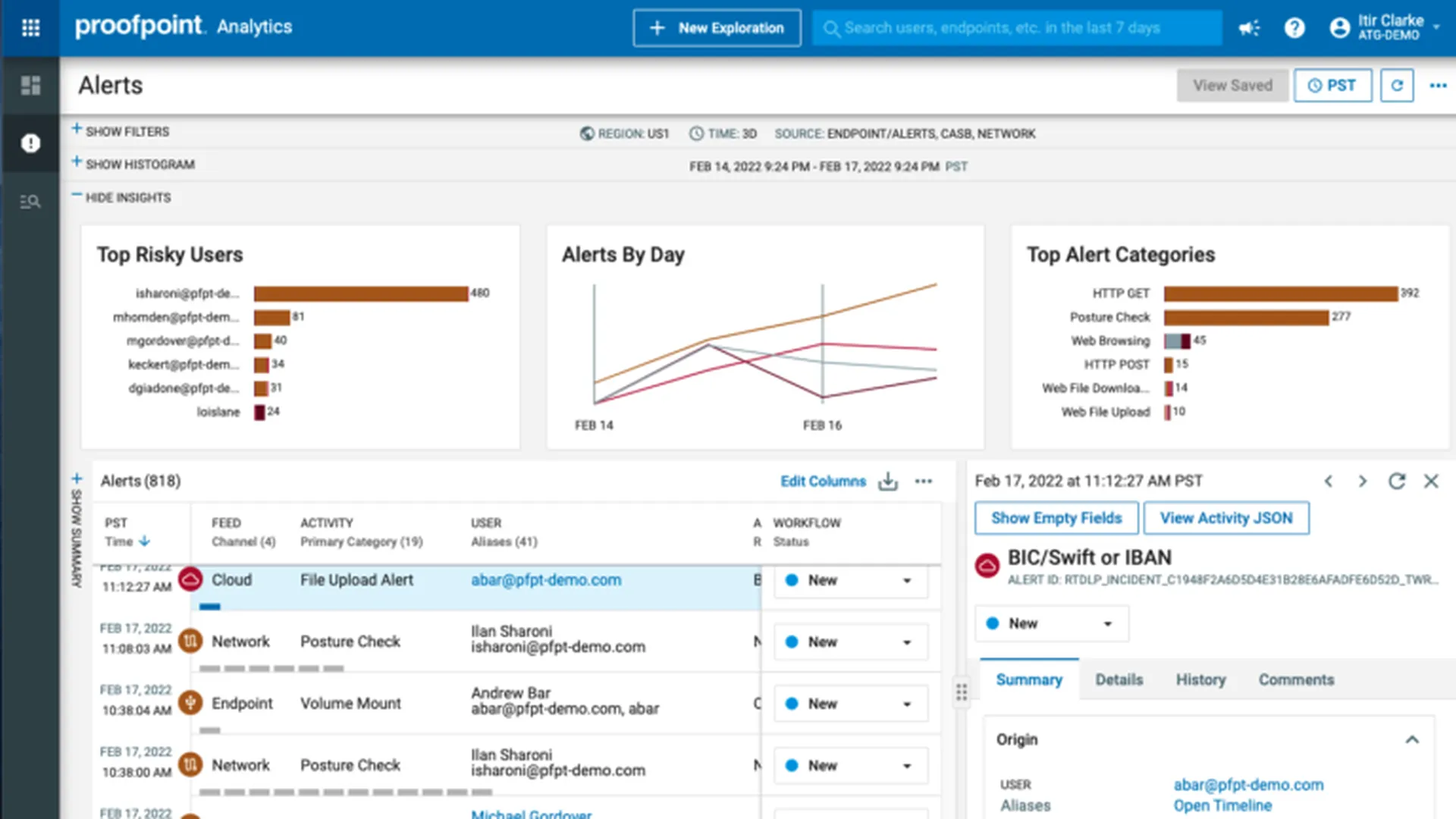
Best for: Organizations aligning awareness efforts closely with email security strategy
Where it stands out:
- Phishing simulations informed by real threat intelligence
- Strong alignment with email security workflows
- Effective for phishing-focused defense programs
Where to pressure-test:
- Heavily focused on email as the primary risk vector
- Less emphasis on broader human behavior across channels
- HRM capabilities are layered onto existing awareness models
When this is the wrong choice:
- If you want full-spectrum human risk management beyond phishing
- If your priority is behavior change across multiple attack surfaces
Comparison table: Best human risk management software
How to evaluate human risk management platforms
Once you have a shortlist, the job changes.
You are no longer asking, “Which vendors are in this category?”
You are asking, “Which platform can actually reduce human risk in our environment?”
That requires a more disciplined evaluation framework because many platforms can demo well, but far fewer can support a mature, measurable HRM program after rollout.
1. Can the platform measure human risk at the user level?
This is the first filter and often the most revealing one.
A true human risk management platform should help you understand:
- Which users are high-risk
- Which teams or roles create more exposure
- How behavior changes over time
- Where interventions are working, stalling, or failing
If the platform mainly reports on completion rates, click rates and campaign summaries it may still be useful, but it is likely operating closer to awareness training than full HRM.
What to look for:
- Individual and group-level risk scoring
- Behavioral trend analysis over time
- Visibility by role, business unit, or risk segment
- Clear distinction between activity metrics and risk metrics
2. Does it adapt interventions or just schedule them?
This is one of the clearest differences between awareness-first tools and behavior-first platforms.
Many tools can deliver phishing campaigns, training modules, reminders and standard follow-up content.
But fewer can adapt based on things like user skill, reporting behavior and changing threat patterns. A strong HRM platform should not treat every user the same.
What to look for:
- Adaptive phishing difficulty
- Personalized learning paths
- Behavior-triggered micro-training
- Interventions that change based on improvement or decline
3. Can it prove measurable behavior change?
This is where many buying processes become vague and where the strongest teams get sharper.
You should be able to answer:
- Are users making better decisions over time?
- Are reporting behaviors improving?
- Are repeat-risk users improving faster?
- Is the organization becoming more resilient in ways leadership can understand?
The key is not just whether the platform generates data. It is whether that data supports a credible risk reduction story.
What to look for:
- Time-based improvement reporting
- Repeat-user behavior tracking
- Evidence of reduced exposure or stronger reporting outcomes
- Executive-ready metrics tied to business risk, not just training activity
4. How strong is the platform’s reporting and threat response workflow?
Human Risk Management should not live in a silo. The most valuable platforms connect human behavior to operational security workflows, especially around threat reporting, triage and escalation.
This matters because the best HRM programs do more than teach users to avoid mistakes. They help users become a more reliable part of detection and response.
What to look for:
- Built-in or integrated threat reporting workflows
- Fast feedback to users after actions are taken
- Clear reporting dashboards for admins and leadership
- Ability to operationalize human-generated signals
5. Does it fit your security operating model?
A platform can be strong in theory and still be the wrong fit in practice.
Some teams need low admin overhead and straightforward awareness coverage. Others need deep analytics, SOC alignment and more advanced segmentation.
The right platform depends on how your team actually operates, not just what looks strongest in a demo.
What to pressure-test:
- Admin effort after rollout
- Ease of configuration and maintenance
- Fit with your security team’s maturity
- Whether the platform supports the workflows you already rely on
6. How well does it integrate with your stack?
Integration matters because human risk does not exist in isolation.
The more mature the program, the more useful it becomes when it can connect to:
- Email environments
- Identity systems
- Reporting channels
- Security operations workflows
- Existing awareness or compliance programs
A platform that cannot share context or fit into the rest of your environment may create more friction than value.
What to look for:
- Email platform compatibility
- Identity and directory integration
- Reporting workflow support
- API access or integration flexibility
- Alignment with broader security tooling
7. Is the platform optimizing for awareness, analytics, or behavior change?
This question sounds simple, but it clarifies almost everything.
Most vendors tilt toward one of three models:
This is often the most useful internal alignment question of the whole evaluation process.
Because once you know what outcome you want, the shortlist usually becomes much clearer.
A practical buyer checklist
Use these questions during demos, trials, or RFPs:
- Can you show user-level risk scoring, not just campaign results?
- How does the platform adapt for users who improve – or don’t?
- What evidence can you provide of behavior change over time?
- How does the platform support real threat reporting, not just simulations?
- What integrations matter most to get full value from the platform?
- How much ongoing admin work is required after launch?
- What does success look like after 6 or 12 months?
If a vendor answers these clearly, you are likely looking at a serious HRM contender.
Which human risk management platform Is right for your use case?
Most human risk management platforms are optimized for a specific outcome like phishing resilience, awareness, or analytics. Only a small number are designed to reduce human risk continuously across the organization.
The strategic difference most buyers miss
Most platforms in this space are optimized for a single layer:
- Phishing tools → detection of one attack vector
- Awareness platforms → content delivery at scale
- Analytics tools → visibility into risk
But human risk does not exist in layers, It;s continuous. The platforms that perform best long-term are the ones that combine measurement, intervention, and real-world behavior into a single system. This is where the gap between HRM as a feature and HRM as an operating model becomes visible.
Sources
Hoxhunt Reviews (G2, Gartner, TrustRadius, Capterra, Software Advice)
CybSafe Reviews (Gartner Peer Insights, FeaturedCustomers)
KnowBe4 Reviews (Gartner, G2, FeaturedCustomers)
Proofpoint Reviews (Gartner, G2, Capterra)
Mimecast Engage Reviews (Gartner, G2, TrustRadius)
Frequently asked questions
What is human risk management (HRM) software?
HRM software measures how employees actually behave against real and simulated threats, scores the resulting risk at the individual level, and delivers adaptive interventions to reduce it over time. It goes beyond the completion-based model of traditional security awareness training by focusing on observable behavior rather than course completion.
How is HRM software different from security awareness training?
Security awareness training teaches; human risk management reduces measurable risk. SAT tracks completions and quiz scores, while HRM tracks behavior change, reporting quality, and risk reduction over time. The gap is visible in the numbers: completion-based training sees reporting around 10%, while behavior-change programs push it above 20% (Hoxhunt Phishing Trends Report 2026).
Is completion-based security awareness training enough on its own?
Completion-based training proves attendance, not behavior, and tends to plateau: employees in completion-based awareness training report threats at roughly 10%, while behavior-change programs push reporting above 20% (Hoxhunt Phishing Trends Report 2026). If your goal is measurable human-risk reduction rather than coverage alone, prioritize a platform built around continuous behavior change, not course completion.
Does human risk management actually reduce risk?
It does when it measures behavior over time rather than completion. In Hoxhunt’s 2026 dataset, real-threat detection rose from 13% to 71% across the training curve and reporting of suspicious messages improved roughly 6× within six months (Hoxhunt Phishing Trends Report 2026, pp. 6, 37–39).
What is the best human risk management software in 2026?
It depends on the outcome you need. For fast phishing resilience, phishing-focused platforms and established names such as KnowBe4 and its alternatives are common picks; for risk visibility and analytics, CybSafe; for continuous, measurable behavior change with real threat reporting, Hoxhunt. Use one test: does the platform continuously measure behavior, score risk, and adapt interventions at the individual level?
How much does human risk management software cost?
Pricing is usually per user per year and varies with workforce size, the modules included, and how much behavior-change capability you need. Most vendors quote custom pricing rather than public list prices, so evaluate cost against measurable risk reduction, not just the per-seat figure.